
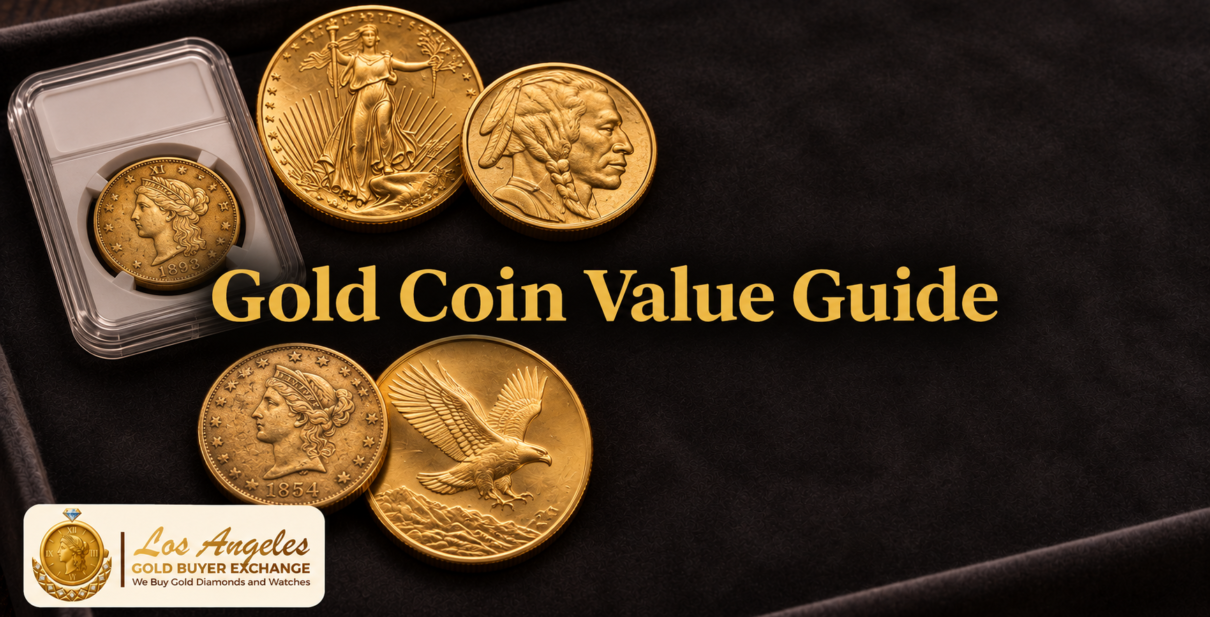
If you have gold coins, whether you bought them as an investment, collected them over the years or inherited them, there are really two questions: how much gold is in them, and is the coin worth more than its gold?
The answer is the difference between melt value and collector value. Most modern bullion coins sell close to their gold content. Some older or rare coins can be worth significantly more. This guide explains how to tell the difference and how cash for gold coin buyers in Los Angeles price what you bring in.
Before we start: gold coin values follow the gold market, which moves every trading day, and collector demand changes over time. Treat this article as a guide, not a quote. An in-person evaluation is the only way to know what your coins are worth today.
Melt Value vs. Collector Value: What’s the Difference?
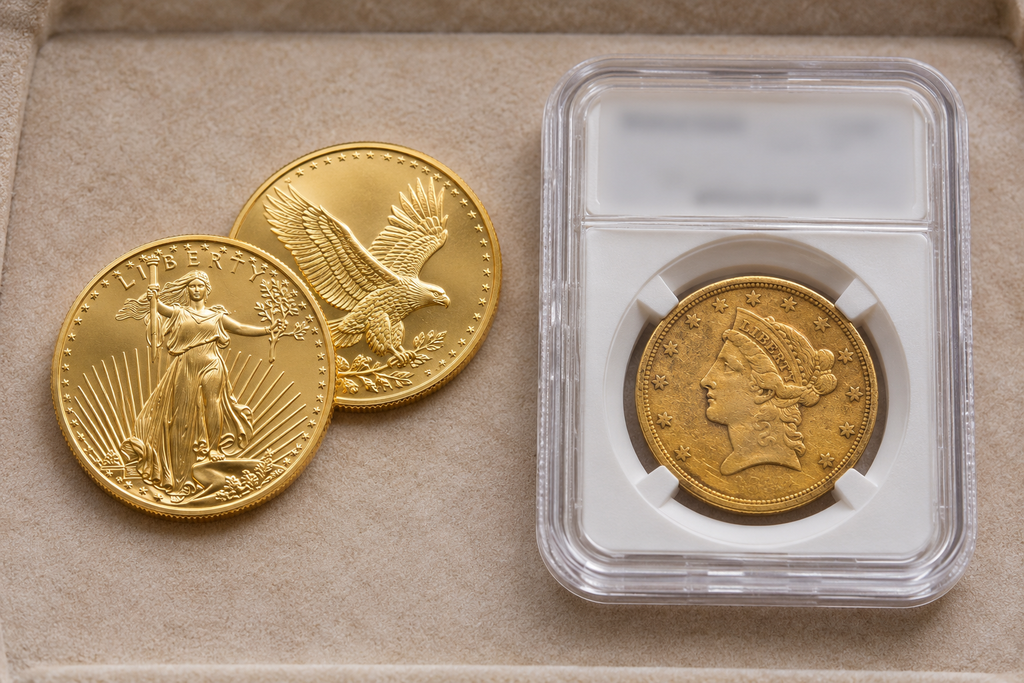
Melt value is what the gold in a coin is worth based on its pure gold content and today’s gold price. It’s the floor value, the minimum a genuine gold coin is worth.
Collector value, also called numismatic value, is any extra value a coin has because of its rarity, age, condition, mint mark or historical interest. Collectors pay a premium for coins that are hard to find or in exceptional condition.
| Melt value | Collector value | |
| Based on | Gold content × spot price | Rarity, condition, demand |
| Typical coins | Modern bullion coins (Eagles, Maple Leafs, Krugerrands) | Pre-1933 U.S. gold, rare dates, high-grade certified coins |
| How often it changes | Every trading day, with the gold price | More slowly, with collector demand |
Most coins people bring in are valued mainly on melt value. Older and rarer coins may be worth melt value plus a collector premium.
How to Calculate a Gold Coin’s Melt Value
The basic formula is simple:
Melt value = fine gold content (troy ounces) × current gold spot price
The key is fine gold content, the amount of pure gold in the coin, which is not always the same as its total weight. For example, the U.S. Mint strikes the American Gold Eagle to the 22-karat standard (91.67% gold, with silver and copper added for durability), so the 1 oz coin’s total weight is about 1.09 troy ounces. The American Gold Buffalo, by contrast, is .9999 fine 24-karat gold.
To find today’s spot price, check a live source like the Kitco gold price chart, which shows the price per ounce and per gram.
Why a buyer’s offer is below melt value
A gold buyer’s cash offer is typically a percentage of melt value. The difference covers refining or resale costs, testing and handling, plus market risk, since the gold price can move before the buyer resells. A reputable buyer will show you the spot price and gold content they used and explain the gap.
Common Gold Coins and Their Gold Content
These are the gold coins we see most often in Los Angeles. Fine gold content is what drives melt value.
| Coin | Purity | Fine gold content (1 oz size unless noted) |
| American Gold Eagle | 22K (.9167) | 1 troy oz (also in ½, ¼, 1/10 oz) |
| American Gold Buffalo | 24K (.9999) | 1 troy oz |
| Canadian Gold Maple Leaf | 24K (.9999) | 1 troy oz |
| South African Krugerrand | 22K (.9167) | 1 troy oz |
| Austrian Gold Philharmonic | 24K (.9999) | 1 troy oz |
| Mexican 50 Pesos (Centenario) | .900 | 1.2057 troy oz |
| British Gold Sovereign | 22K (.9167) | 0.2354 troy oz |
| U.S. $20 Double Eagle (pre-1933) | .900 | 0.9675 troy oz |
Notice that 22-karat coins like the Eagle and Krugerrand contain a full ounce of gold. The extra alloy makes the coin heavier and more scratch-resistant, not less valuable.
Don’t see your coin? We also evaluate Chinese Pandas, Australian Kangaroos, British Britannias, and foreign and commemorative gold coins. See the full list on our gold coins and bullion page.
When Is a Gold Coin Worth More Than Its Gold?
Some coins are worth melt value plus a premium. Here’s what to look for.
Pre-1933 U.S. gold coins
Before 1933, the U.S. minted gold coins for everyday use, in $1, $2.50, $3, $5, $10 and $20 denominations. Liberty Head and Saint-Gaudens designs are popular with collectors. Common dates in average condition often sell near melt value. Scarcer dates, mint marks and well-preserved examples can carry significant premiums.
Graded and certified coins
Coins sealed in a plastic holder (a “slab”) by a professional grading service have a certified grade. A high grade can add meaningful value, especially for older coins. Keep slabbed coins in their holders.
Proof and special-finish coins
Proof coins are struck with special dies for a mirror-like finish and are sold to collectors. Proof versions of bullion coins, especially with original boxes and certificates, may sell above melt.
Low-mintage and key dates
Coins produced in small numbers, or key dates in a series, are harder to find, which collectors value.
Condition matters
For collectible coins, condition is everything. Wear, scratches, cleaning and damage can reduce or erase a collector premium. For bullion coins, condition matters much less, because value is mostly in the gold.
Collector premiums change with demand and aren’t guaranteed. A coin worth a premium today may sell closer to melt later, or the reverse.
What About Gold Bars and Rounds?
Gold bars and rounds are valued almost entirely on their gold content.
- Sizes. Bars range from 1 gram to 1 kilo. Common sizes include 1 oz, 10 oz and 100 grams.
- Refiner and assay card. Bars from recognized refiners, such as PAMP Suisse, Valcambi, Perth Mint and the Royal Canadian Mint, are easy to verify. Keep sealed bars in their original assay packaging.
- Serial numbers. Many bars carry a serial number that matches the assay card.
- Rounds. Rounds look like coins but are made by private mints and have no face value. They’re valued like small bars.
Large bars or big collections? We recommend calling ahead so we can prepare for your visit.
Mistakes That Can Lower Your Coin’s Value
- Cleaning your coins. This is the most common and costly mistake. Polishing or cleaning leaves fine scratches that collectors spot immediately and can wipe out a coin’s premium.
- Removing coins from slabs or original packaging. Certified holders and mint packaging help prove authenticity and grade.
- Handling coins by their faces. Hold coins by the edges. Fingerprints can damage surfaces over time.
- Selling collectible coins as scrap. Have older coins evaluated individually before accepting a melt-only price.
- Selling coins mounted in jewelry without asking. A coin in a pendant or bezel is evaluated separately from the mounting, so ask the buyer to value both.
- Accepting an offer without understanding it. Ask what spot price and gold content were used.
Coins from a family estate? Read Selling Inherited Jewelry in Los Angeles for more tips on handling inherited valuables.
Selling Gold Coins at LA Gold Buyer Exchange
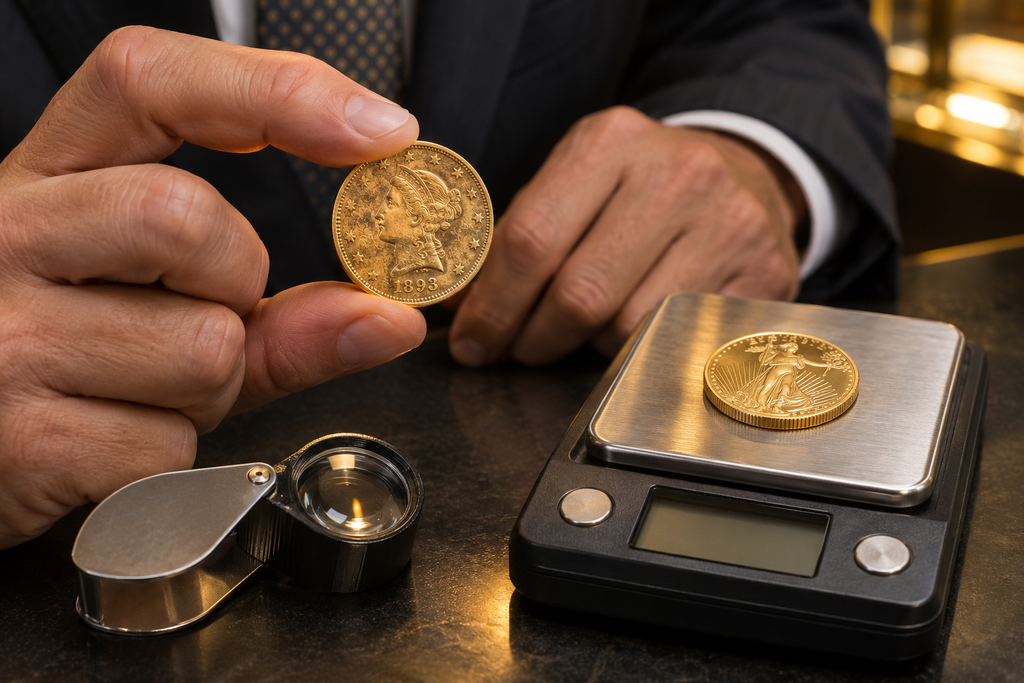
LA Gold Buyer Exchange has bought gold in Los Angeles since 2011, and every coin gets an individual evaluation, not a bulk melt price.
- Bring your coins or bars and a photo ID. Don’t clean them first.
- We identify each item: mint, date, denomination and size.
- We verify and weigh using non-destructive methods and state-certified scales, in front of you.
- You review the offer item by item, based on gold content, today’s spot price and any collector value. Take your time, ask questions or get another quote.
- Same-day payment if you accept, or take your coins home with no obligation.
For details on the coins, bars and brands we buy, see Sell Gold Coins & Bullion for Cash in Los Angeles. Have gold jewelry too? See our scrap and broken gold service or the main cash for gold page.
Walk in at a location near you, including Harvard Heights, Florence, Willowbrook and View Park–Windsor Hills, or see all locations.
Frequently Asked Questions
How do I know if my gold coin is worth more than melt value?
Look at the date, mint mark, condition and whether the coin is certified. Pre-1933 U.S. gold coins, proofs, rare dates and high-grade certified coins are the most likely to carry a premium. An in-person evaluation will confirm it.
How is a gold coin’s melt value calculated?
Multiply the coin’s fine gold content, in troy ounces, by the current gold spot price. Fine gold content is the pure gold in the coin, which can differ from its total weight.
Why is a 22-karat Gold Eagle worth the same as a 24-karat Buffalo?
Both 1 oz coins contain one troy ounce of pure gold. The Eagle simply has extra alloy added, which makes it heavier and more durable.
Should I clean my gold coins before selling?
No. Cleaning can damage the surface and reduce or eliminate any collector value. Bring them as they are.
Why did my coin’s offer change from last week?
Coin offers are tied to the gold price, which moves every trading day. Collector premiums also shift with demand.
Do you buy foreign and commemorative gold coins?
Yes. We evaluate a wide range of foreign, commemorative, proof and estate coins.
Is it better to sell to a coin shop, pawn shop or gold buyer?
It depends on what you have. For bullion and common gold coins, a dedicated gold buyer typically offers competitive prices based on gold content. Read Pawn Shops vs. Gold Buyers in LA to compare.
Find Out What Your Gold Coins Are Worth
Whether you have a single Gold Eagle or a full collection, LA Gold Buyer Exchange will evaluate each coin individually, explain your offer and pay you the same day if you decide to sell.
Get a free gold coin and bullion evaluation or contact us to plan a visit for a larger collection.
Disclaimer: All cash offers depend on the current gold spot price, verified gold content, condition, collector demand and an in-person evaluation of each item. Melt value is a metal-value benchmark, not a guaranteed purchase offer. The information in this article is for general guidance only and is not a price quote or appraisal.